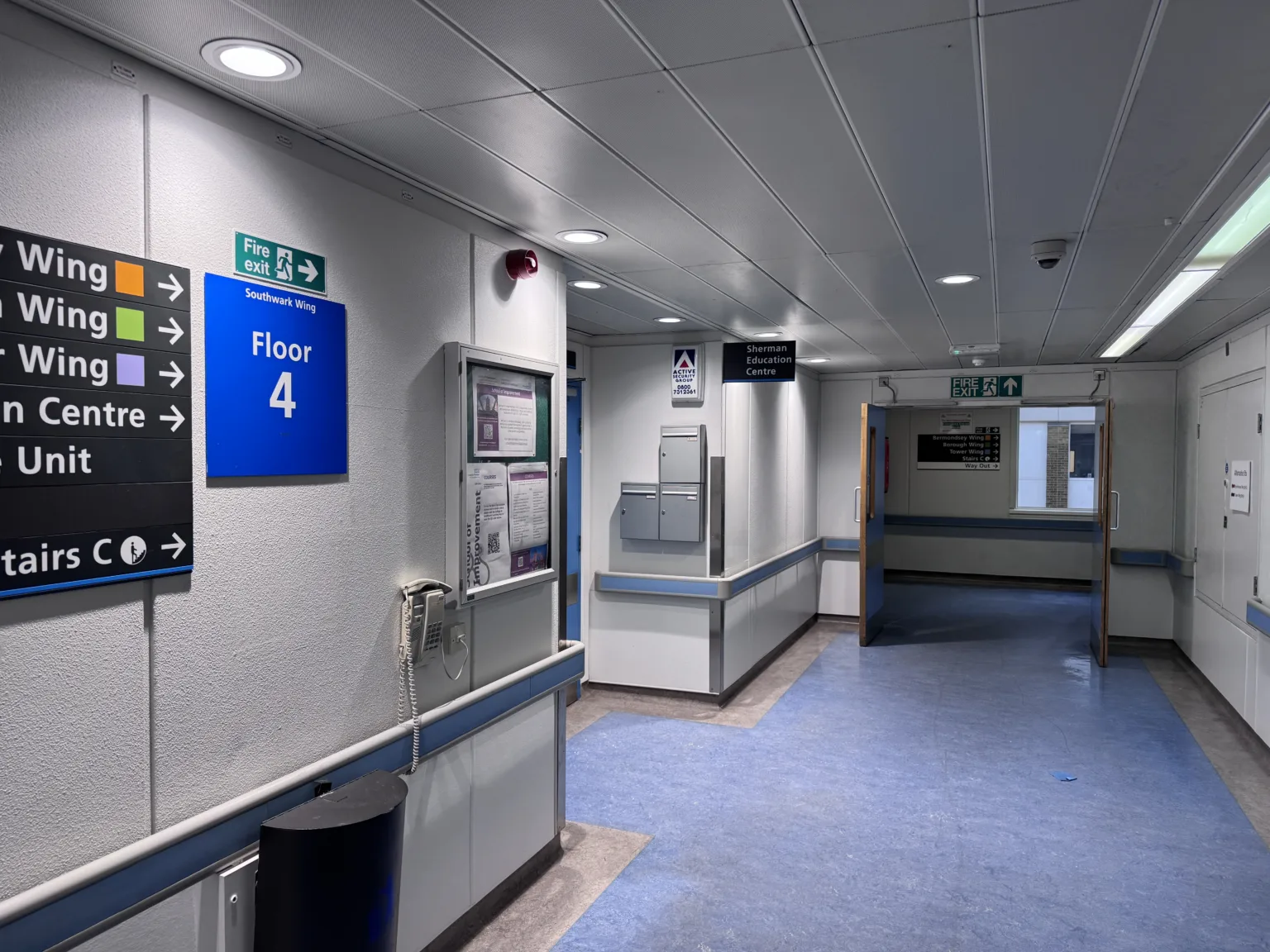
Lighting in hospitals is a critical component of clinical safety, patient recovery, and staff productivity and wellbeing. In the UK, healthcare lighting design is strictly governed by CIBSE LG2 (2019) for visual performance, HTM 06-01 for electrical resilience, and the revised BS 5266-1:2025 for emergency safety.
These standards are driving engineers and estates teams to move beyond basic horizontal lux levels so as to ensure systems support complex 24-hour clinical operations while maintaining regulatory compliance.
This guide explains the key standards, typical lux levels required in hospitals and common mistakes to avoid when designing lighting for healthcare buildings.
Key Hospital Lighting Standards
CIBSE LG2 – Lighting for Healthcare Premises
The 2019 edition of LG2 aligns UK guidance with European Standards, shifting the focus from simple task lighting to holistic environments that account for circadian health. It provides specific mandates for:
- Layered Lighting Scenes: Wards now require up to six distinct lighting scenes, including night-time “watch lights” (15–20 lx) and rest periods where light on a patient’s pillow must not exceed 0.5 lx .
- Clinical Accuracy: Clinical observation requires high color rendering (minimum Rₐ90) to detect subtle physiological changes like cyanosis or rashes.
- Aging Eye Considerations: Designs must account for elderly patients who may require significantly higher illuminance to achieve the same visual performance as younger staff.
HTM 06-01 – Electrical Services Supply and Distribution
HTM 06-01 manages the “duty of care” through engineering governance. It categorizes hospital areas into five Clinical Risk Categories to determine power resilience:
- Categories 1–4: Require varying levels of standby generator support with restoration times under 15 seconds.
- Category 5 (Critical Care): Operating theatres and life-support areas require instantaneous “no-break” power via Uninterruptible Power Supplies (UPS).
- Segregation: Essential circuits must be physically segregated from non-essential supplies to prevent localized faults from causing total system failure.
BS5266 – Emergency Lighting Requirements
BS5266 is the British Standard governing emergency lighting systems. Hospitals require robust emergency lighting because evacuation procedures can involve vulnerable patients and complex building layouts.
Emergency lighting systems must ensure:
- safe evacuation routes
- adequate illumination of exits
- visibility of safety equipment
- regular testing and maintenance
Modern systems often incorporate automated testing and monitoring, reducing manual inspections and improving compliance reporting for estates teams.
The 2025 revision introduces stricter mandates for life safety:
- New Categories: Emergency lighting now formally covers Escape, Local Area (for staying in place during failure), and Standby lighting.
- Wiring Resilience: A single fault must not affect more than 20 luminaires, and high-risk areas require dual-supply circuits.
- Verification: Mandatory photometric verification is now required every five years to ensure aged systems still meet safety illuminance targets.
Hospital Lighting Lux Levels
The lighting levels required in hospitals vary depending on the clinical activity taking place.
Typical illuminance levels referenced in healthcare guidance include:
| Hospital Area | Maintained Illuminance (Lux) | Technical Requirement / Notes |
|---|---|---|
| Patient wards | 100 lx | Ambient lighting for movement |
| General Nursing Care | 300 lx | Required for active bedside care |
| Bedside Examination | 1,000 lx | Formal clinical exam (often portable/specialized) |
| Operating Theatre | 1000 lx | Background room lighting |
| Operating Table | 10,000–160,000 lx | High-intensity surgical task lighting |
| Corridors (Day) | 200 lx | Consistent with circulation safety |
| Corridors (Night) | 50 lx | Reduced for rest; must maintain 0.5 lx max on pillows |
| Nurse Stations | 300 lx (Ambient) / 500 lx (Task) | High-task accuracy for medical records |
| Treatment Rooms | 500 lx (Gen) / 1,000 lx (Detailed) | 1,000 lx for minor surgical procedures |
In many clinical environments, vertical lighting levels are equally important as horizontal lux levels, as clinicians need to clearly observe patients and medical equipment.
Emergency Lighting Requirements in Hospitals
Emergency lighting systems in hospitals must support safe evacuation and continued operation during power failures. Automated emergency lighting monitoring systems can simplify testing and provide centralised compliance reporting.
Emergency lighting requirements, under BS 5266-1:2025, include:
- Time: Systems must activate within 0.5 to 5 seconds depending on the risk .
- Escape Routes: Minimum 1 lx across the whole floor width (not just the center line).
- Safety Equipment: Fire call points, extinguishers, and first aid posts require 5 lx vertical illuminance.
- High-Risk Tasks: 10% of normal lighting or 15 lx (whichever is greater) within 0.5 seconds .
- Duration: 3-hour minimum battery duration is mandatory for hospitals (sleeping accommodation).
Common Hospital Lighting Design Mistakes
Even when standards are referenced, hospital lighting schemes can fail to meet operational needs if certain factors are overlooked.
- Designing only for horizontal lux levels – Clinicians rely heavily on vertical illumination to observe patients, equipment and surfaces.
- Poor glare control – Excessive glare can affect both staff performance and patient comfort, particularly in wards and recovery areas. Luminaires should be offset from the bed centerline and use diffusers rather than open “pods” to prevent discomfort for bed-bound patients.
- Overlooking maintenance – Hospitals operate continuously, so lighting systems should minimise disruption during servicing and testing.
- Treating lighting as a standalone system – Modern hospital lighting increasingly forms part of smart building infrastructure, enabling energy monitoring, occupancy control and automated emergency lighting testing.
- Neglecting the Modeling Ratio: Designs should maintain a modeling ratio (the balance of diffuse to direct light) between 0.3 and 0.6 to help clinicians define shapes and textures in complex bedside environments.
- Static Color Rendering: Using Rₐ80 in clinical zones where Rₐ90 is required for diagnostic accuracy.
- Manual Compliance Reporting: Modern estates require automated testing systems to log BS 5266 compliance data without disrupting 24/7 clinical activities .
Lighting for Modern Healthcare Buildings
Hospital lighting systems now play a wider role within building infrastructure.
Energy-efficient luminaires, intelligent controls and integrated emergency monitoring allow healthcare facilities to reduce operational costs while improving system visibility and compliance reporting.
For consultants and estates teams working on hospital refurbishments or new facilities, understanding how LG2, HTM and BS5266 interact is essential for delivering safe and compliant lighting schemes.
This article is intended as a general guide to hospital lighting standards and typical design considerations. Lighting requirements may vary depending on the specific building, clinical use and applicable regulations. Always refer to the latest versions of CIBSE LG2, HTM guidance and BS5266 standards, and seek professional advice when developing lighting designs for healthcare environments.