Hospitals are among the most energy-intensive properties in the UK commercial and public sectors. Operating 24 hours a day, 365 days a year, these estates rely heavily on extensive building services to maintain sterile, safe and legally compliant environments. Within this infrastructure, hospital lighting represents one of the most accessible and high-yield opportunities for energy demand reduction and carbon abatement.
According to the UK Government’s Energy Consumption in the UK (ECUK) datasets and NHS England’s Estates Returns Information Collection (ERIC), lighting traditionally accounts for approximately 20–30% of total electricity consumption within healthcare environments. This baseline is particularly pronounced in legacy, un-refurbished estates still reliant on inefficient fluorescent T8/T5 lamps or high-intensity discharge (HID) external systems.
For NHS Trusts and private healthcare operators working toward net-zero targets, reducing lighting energy is no longer a simple matter of swapping lamps. The greatest long-term financial and operational gains are unlocked by combining ultra-efficient LED technology, intelligent wireless control topologies, circular economy retrofit principles, and automated compliance monitoring.
Why Hospital Lighting Demands Substantial Energy
Unlike standard commercial offices designed for standard 12-hour weekday occupancy, hospital facilities exhibit a complex matrix of operational requirements:
- Continuous 24/7 Circulation Zones: Corridors, stairwells, and emergency reception areas must remain illuminated around the clock to ensure patient safety and rapid transit.
- High-Lux Clinical Task Lighting: Areas such as operating theatres, pathology labs, and intensive care units (ICUs) demand stringent illuminance thresholds, often requiring maintained illuminance levels (Eₘ) between 500 lx and 1,000 lx on the task plane.
- Strict Regulatory Frameworks: All systems must strictly comply with the Chartered Institution of Building Services Engineers (CIBSE) Lighting Guide 2 (LG2: Healthcare Premises), Health Technical Memorandum (HTM) 06-01 (Electrical services supply and distribution) and BS 5266-1 (Emergency lighting).
LED Efficacy vs. System Control
Upgrading to solid-state LED technology is the fundamental baseline of any energy reduction strategy. Modern healthcare-grade luminaires regularly achieve systemic luminous efficacies of 140 lm/W to 170 lm/W, compared to the sub-80 lm/W typical of aging fluorescent alternatives. This transition immediately slashes the connected load by more than 50%.
For example, a traditional 4×18 T8 recessed modular luminaire with a magnetic ballast draws approximately 82 circuit watts. Replacing this with a modern, optically optimised 28W LED panel delivers superior lux delivery while capturing an immediate 65% reduction in energy consumption. However, relying solely on a point-for-point luminaire swap leaves substantial savings on the table. If a highly efficient 170 lm/W luminaire is left burning at 100% output in an unoccupied back-of-house corridor or a daylight-flooded atrium, it is still wasting energy. To maximise the return on investment, LED hardware must be married to intelligent control frameworks.
Unlocking Savings via Intelligent Controls
Data from the International Energy Agency (IEA) and the Carbon Trust confirms that integrating LED luminaires with advanced lighting control systems typically yields total energy savings of 60–80% compared to legacy systems.
These architectures exploit several core control methodologies:
| Control Strategy | Technical Mechanism | Primary Healthcare Application |
|---|---|---|
| Occupancy Detection | Passive Infrared (PIR) or Microwave sensors drop lighting to a 10% comfort baseline or turn off completely during periods of zero traffic. | Corridors, toilets, consultation rooms, plant rooms, and back-of-house areas. |
| Daylight Harvesting | Photometric sensors continually monitor incoming natural light and dim the internal LED output linearly to maintain a constant target lux level (e.g., 500 lx). | Atriums, perimeter wards, entrance lobbies, and glazed circulation links. |
| Zoned Corridors & Institutional Scheduling | Systemic astronomical clocks and software grouping alter illumination profiles based on shift changes, visiting hours, or nocturnal periods. | Public concourses, outpatient departments, and multi-bed wards. |
Overcoming the Retrofit Barrier via Wireless Networks
Historically, deploying sophisticated controls across a live hospital estate required installing dedicated data buses, such as hardwired DALI cabling. In older hospital wings, this invasive process introduces operational disruption, infection control risks, and potential complications involving asbestos containment in ceiling voids.
To circumvent this, modern specifications require secure, industrial-grade wireless mesh control topologies. By embedding nodes directly within individual luminaires, each light fitting acts as a decentralised transmitter and receiver. This forms a self-healing, encrypted wireless network that completely removes the need for data control wiring, accelerating installation timelines within live, fully operational clinical environments.
Automated Emergency Lighting Testing
Statutory compliance with BS 5266-1 dictates that emergency luminaires undergo monthly functional checks (testing the inverter and battery switchover) and an annual full-duration 3-hour discharge test. Across an expansive NHS estate spanning thousands of individual fittings, performing manual inspections is an incredibly intensive process that drains engineering resources.
By deploying intelligent emergency lighting integrated into a centralised control platform, compliance is completely automated:
- Automated Scheduling: Functional and duration tests are programmatically executed during low-risk hours without manual intervention.
- Real-Time Diagnostics: The central gateway actively polls the estate, generating immediate maintenance alerts detailing the exact location, luminaire ID, and fault type.
- Digital Audit Trails: Test results are automatically compiled into a secure cloud-based logbook, providing estates teams with proof of compliance for Care Quality Commission inspections.
Retrofit vs. Full Replacement
A key priority for NHS Procurement and Estates teams is balancing asset modernisation with budgetary constraint and sustainability criteria. A full luminaire replacement requires removing the entire existing metal chassis out of the ceiling grid, creating significant packaging waste and material disposal considerations.
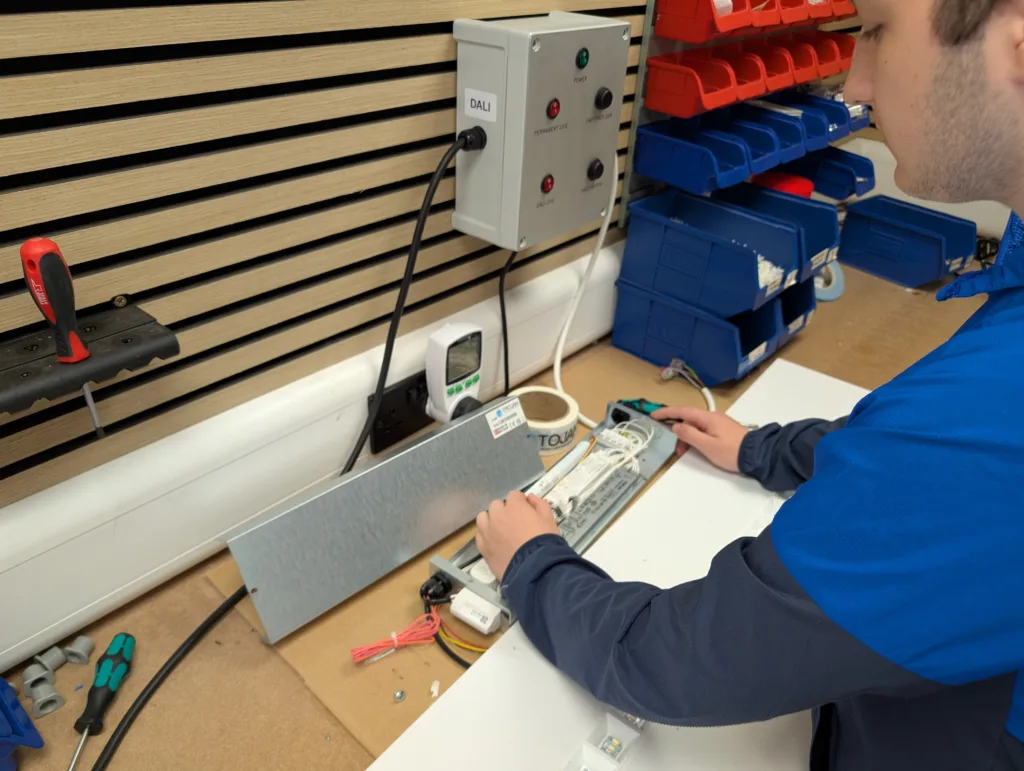
Where structurally appropriate, a gear-tray retrofit strategy offers a compelling alternative that aligns with circular economy principles.
By retaining the steel housing of the original luminaire, hospitals can reduce capital component costs, cut installation times per point by up to 50%, and significantly lower the embodied carbon of the project. Furthermore, because the structural integrity of the ceiling remains undisturbed, this method drastically minimises the risk of releasing airborne contaminants, making it an ideal approach for live hospital environments.
Lighting as an Asset in Smart Hospital Infrastructure
Modern wireless lighting networks are no longer isolated electrical circuits; they serve as an enterprise-grade digital backbone for the wider Internet of Things (IoT) in healthcare. Because lighting is distributed uniformly across 100% of the building’s footprint and is permanently connected to mains power, individual luminaires can be fitted with multi-sensor nodes capable of supporting wider facility management operations:
- Granular Occupancy Analytics: Heat-mapping data collected by PIR sensors can be fed directly into Building Management Systems (BMS) via BACnet or API protocols to dynamically scale back HVAC heating and ventilation rates in empty zones.
- Asset Tracking: Bluetooth Low Energy (BLE) tags embedded within the lighting network can track the real-time location of critical, mobile medical equipment saving thousands of clinical hours spent searching for assets.
- Environmental Monitoring: Integrated sensors can monitor temperature, humidity, and even air quality parameters on a room-by-room basis, ensuring clinical spaces remain strictly within statutory thresholds.
Technical Standards and Design Priorities
Energy minimisation must never come at the expense of patient outcomes, clinical accuracy, or staff well-being. Any proposed lighting upgrade must balance efficiency against the rigorous criteria defined within CIBSE LG2 and HTM 06-01:
- Color Rendering Index (Rₐ): General clinical observation areas require a minimum of Rₐ ≥ 80, but specialised treatment and examination rooms demand an Rₐ ≥ 90 to allow doctors to accurately evaluate skin tone, cyanosis, and tissue condition.
- Glare Control (Unified Glare Rating – UGR): Intensive care units and patient wards require specialised optical shielding and micro-prismatic diffusers to achieve strict glare limits (UGR ≤19), protecting bed-bound patients from direct glare.
- Circadian / Human-Centric Lighting: Advanced schemes utilise dynamic white tuning (varying from a warm 2700K to a crisp 6500K) to mirror the natural solar cycle, helping to stabilise patient circadian rhythms, accelerate recovery times, and combat fatigue in night-shift staff.
Proven Project Outcomes
These models are supported by highly predictable, repeatable financial and operational outcomes across major UK healthcare installations:
Evelina London Children’s Hospital: A comprehensive, multi-phase energy performance contract involving specialised LED luminaires and advanced wireless addressable controls delivered projected first-year electricity savings approaching £400,000, alongside a near-total reduction in routine manual emergency testing.
Peterborough City Hospital: The targeted replacement of more than 15,000 inefficient lamps and luminaires with intelligent LED systems delivered massive, audited reductions in annual kilowatt-hour (kWh) consumption, drastically lowering the estate’s carbon baseline while modernising the facility.
The Path Forward for NHS Estates
As the NHS works toward its legally binding target to reach net-zero carbon emissions for its directly controlled footprint by 2040, optimisation of aging building fabric is critical.
Upgrading legacy lighting infrastructure represents one of the fastest, most scalable, and non-invasive methods to achieve immediate energy security and operational resilience. By transitioning away from basic illumination toward an intelligent, sensor-rich, and circular-economy-focused lighting ecosystem, UK hospitals can simultaneously lower operational expenditure, automate statutory safety compliance, and create vastly improved environments for clinical care.