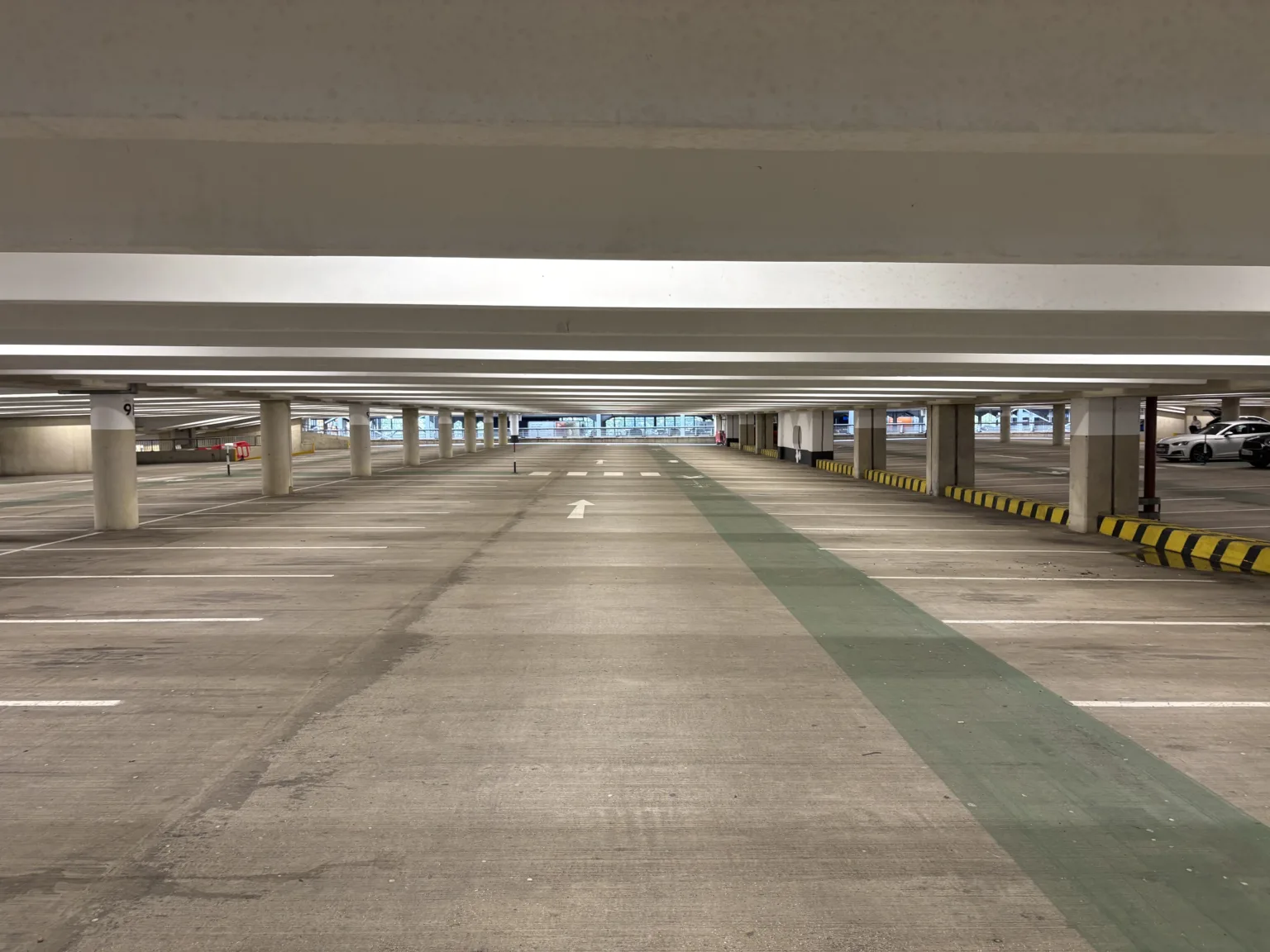
For many estates, be it retail or commercial, a car park is the first and last touchpoint of the customer or employee journey. Yet, car park lighting is often treated as a “set-and-forget” utility until a safety incident occurs, an insurance claim lands on your desk, or energy bills spike.
Upgrading your lighting infrastructure isn’t just about ticking a compliance box. It is a commercial tool to mitigate liability, deter criminal activity, and drastically lower your operating margins.
The Key Standards Explained
Navigating the UK regulatory landscape for car parks involves a mix of British and European standards plus industry-specific guidance notes.
- BS 5489-1: The primary code of practice for designing outdoor lighting. It directly dictates the benchmarks required for public amenity spaces, including open-air, surface-level car parks.
- BS EN 12464-2: This standard regulates lighting for outdoor workplaces. If your car park serves night shifts, logistics teams, or commercial operations, this is your baseline standard.
- BS 5266-1:2025: The updated code of practice for emergency lighting. It outlines the legal requirements for safe evacuation, emergency luminaire testing, and minimum light levels during a power outage.
- EN 1838: The European application standard specifying the precise emergency lighting requirements (such as minimum lux levels and response times) across specified escape routes.
- ILP Guidance (Institution of Lighting Professionals): Offers practical, boots-on-the-ground technical guidance on combating light pollution, glare, and managing urban sky glow in sensitive commercial zones.
Which Standard Applies Where?
| Car Park Type / Area | Primary Lighting Standard | Emergency Lighting Standard |
| Open-Air | BS 5489-1 / BS EN 12464-2 | BS 5266-1:2025 / EN 1838 (For external routes) |
| Multi-Storey / Covered Deck | BS EN 12464-1 | BS 5266-1:2025 / EN 1838 |
| Underground Parking | BS EN 12464-1 | BS 5266-1:2025 / EN 1838 |
Lighting Design Fundamentals
A compliant lighting layout balance several critical physical metrics. Simply choosing high-wattage floodlights creates blind spots and harsh shadows. Good lighting relies on these key parameters:
- Illuminance (Lux): The total amount of light landing on a surface area.
- Uniformity (U₀): The ratio of minimum light to average light (Eₘᵢₙ/Eₐᵥ). A uniformity rating ensures a smooth, predictable transition across the deck, eliminating dark pockets.
- Glare (UGR): Uncontrolled glare blinds drivers and obscures pedestrian movement. Proper optical distribution ensures light is cast downward, not into drivers’ eyes.
- Colour Rendering Index (CRI/Rₐ): A measurement of how accurately a light source reveals true colours. Car parks require high CRI (80≥Rₐ) so that your CCTV system can clearly capture images
- Colour Temperature (CCT): Measured in Kelvin (K). While warm light is excellent for residential hospitality, crisp 4000K cool white light is the commercial standard for car parks, as it enhances alertness and boosts peripheral visibility.
- IP and IK Ratings: Car parks can be brutal environments. Luminaires must feature high Ingress Protection (IP65 or IP66) to seal out dust and high-pressure jet washes, paired with an IK10 impact rating to withstand vandalism, low-clearance vehicle strikes, and accidental damage.
Zone-by-Zone Lighting Requirements
Light distribution must adapt to specific architectural zones to manage human eye adjustment, especially when transitioning from bright outdoor daylight into a darker, enclosed spaces.
| Car Park Zone | Average Illuminance (Eav) | Uniformity (U0) | Minimum CRI (Ra) | Key Design Consideration |
| Outdoor Surface Car Parks | 5 – 20 lux | ≥ 0.25 | 20 – 40 | Varies by traffic density; focus on spill light control. |
| Indoor Parking Bays | 50 lux | ≥ 0.40 | 40 | Balanced light to clearly see painted bay markings. |
| Driving Aisles | 75 lux | ≥ 0.40 | 40 | Clear vision for navigating tight columns safely. |
| Pedestrian Walkways | 100 lux | ≥ 0.40 | 40 | Clear sightlines for foot traffic and personal security. |
| Ramps, Entries & Exits | 150 lux | ≥ 0.40 | 40 | High lux levels to mitigate daylight “black hole” effect. |
Emergency Lighting Requirements
When power fails, an enclosed car park becomes pitch black within seconds, sparking immediate panic. Under BS 5266-1:2025, emergency lighting must operate automatically for a minimum duration of 3 hours to allow safe evacuation.
- Defined Escape Routes: Must maintain a minimum of 1 lux along the center line of the floor.
- Open Areas / Anti-Panic Zones: Areas without defined paths require a minimum of 0.5 lux across the entire open space to prevent disorientation.
- High-Risk Task Zones: Ticket machines, barrier controls, and plant rooms require significantly higher illumination levels (typically 15 lux) to allow operators to safely isolate machinery or manage emergency bypass controls.
Intelligent Lighting Controls
Car parks are frequently empty during off-peak night hours, yet safety dictates they cannot be left in complete darkness. Leaving fixtures burning at 100% output is an expensive waste of energy. Modern control systems addresses this challenge.
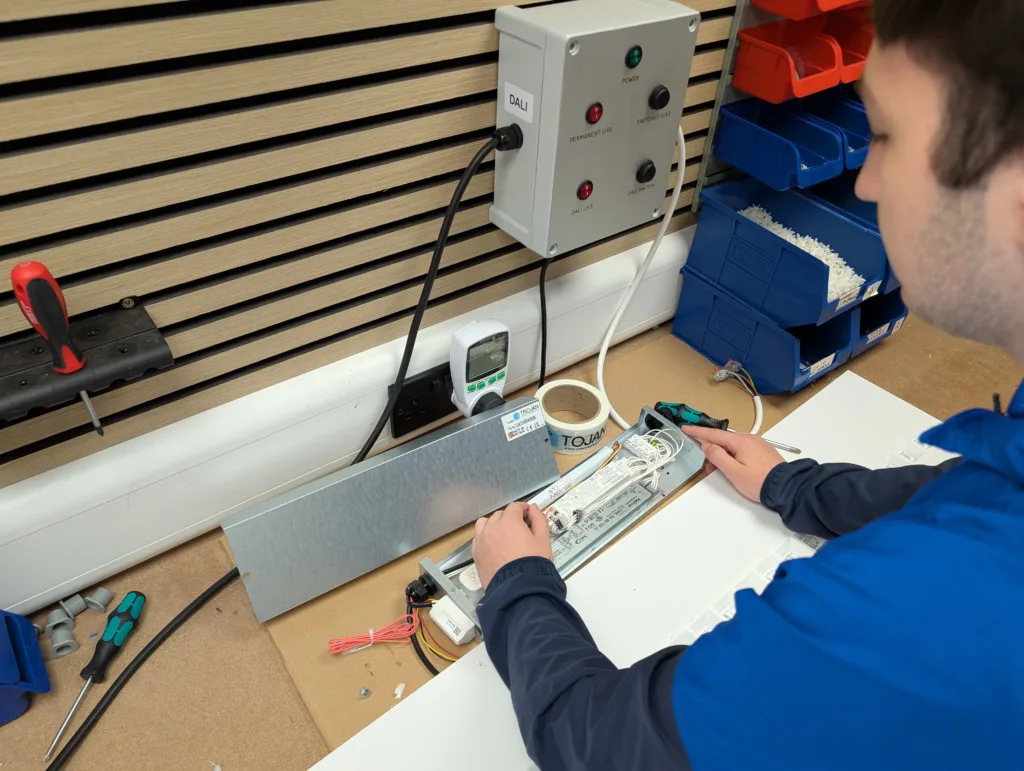
- DALI (Digital Addressable Lighting Interface): A wired, open-protocol system allowing every luminaire to communicate bidirectionally. DALI allows precise grouping, dimming profiles, and automatic fault reporting directly to your central Building Management System (BMS).
- Wireless Mesh Systems: Eliminates data cabling by utilising localised radio frequencies (such as Bluetooth Mesh) between smart fixtures. Ideal for fast-track retrofit projects where routing fresh control cables is cost-prohibitive.
- Hybrid Systems: Combines wired DALI networks on individual decks with wireless links connecting separate levels or detached open-air lots into a single management dashboard.
Real-World Commercial Case Studies
Brent Cross Multi-Storey
We supplied a robust, linear LED system engineered with an IP66 environmental seal and an IK10 impact rating, fully integrated into a wired DALI control network. This upgrade delivered an immediate 68% drop in baseline energy demand while successfully climbing to a balanced 0.42 uniformity rating across all decks. By incorporating intelligent microwave occupancy sensors, the system now automatically dims empty decks down to a 10% background level when vacant, reducing carbon output without compromising on safety or compliance. Read the Brent Cross Lighting case study.
The Oracle
We supplied a full lighting upgrade, introducing a wireless mesh occupancy sensing network combined with smart daylight harvesting along the top-deck perimeters. The deployment achieved an outstanding 72% reduction in annual energy expenditure by ensuring lights only operate at full output when actively needed. Additionally, the integration of automated, remote emergency testing completely transformed their compliance workflow, removing the need for manual maintenance inspections.
West Quay
We engineered a solution featuring bespoke, low-glare asymmetrical precision optics housed within highly durable, IP66-rated linear housings. This design eliminated blinding glare, creating a safer environment navigation while boosting pedestrian walkway brightness to a consistent, highly visible 100 lux. The result is a resilient, low-maintenance installation that significantly improves site safety. Read the West Quay Lighting case study.
Common Specification Mistakes to Avoid
- Over-Illuminating to Fix Safety Issues: Flooding an area with raw, uncontrolled lux creates blinding glare and deep contrast shadows. Focus on uniformity (U₀), not raw lumen output.
- Ignoring the “Black Hole” Effect: Failing to specify 150 lux at daylight entry zones means drivers enter internal decks temporarily blinded while their eyes adjust.
- Low IK Ratings on Low Ceilings: Specifying fragile, low-impact fixtures in multi-storey car parks results in costly, frequent maintenance cycles due to high-clearance of many vehicles.
- Neglecting Emergency Test Accessibility: Installing non-monitored emergency lighting means your team must manually test every fitting with a key switch monthly. Smart DALI or wireless automated testing logs compliance data directly to the cloud, saving hundreds of man hours.
Future Trends: Connected Infrastructure and ESG
The car park luminaire is no longer just a light fixture but an intelligent network node.
- Smart Buildings & The IoT: Modern car park lights can house integrated Bluetooth beacons and asset-tracking sensors, paving the way for smart space utilisation tracking.
- EV Charging Integration: Dynamic lighting control networks can link directly with Electric Vehicle (EV) charging bays, ramping up brightness when a vehicle hooks up, changing colour indicators based on charging status, or shedding load across the grid during peak charging times.
- ESG Priorities & Circular Economy: Commercial real estate investment relies heavily on robust Environmental, Social, and Governance (ESG) scoring. Transitioning to low-carbon, modular fittings designed for a circular economy is crucial for future-proofing your estate.
Frequently Asked Questions
How often must car park emergency lighting be tested?
Under BS 5266-1:2025, you must execute a brief monthly function test to check that every emergency luminaire activates correctly. Annually, a full 3-hour duration test must be performed and recorded in your building logbook to maintain compliance.
What is the ideal colour temperature for car parks?
4000K (Cool White) is widely regarded as the commercial benchmark. It offers crisp contrast, improves peripheral vision for drivers, and optimises CCTV image capture.
Can we reuse existing cabling for an LED and smart control upgrade?
Yes. If you opt for a Wireless Mesh system, you can use existing mains wiring to power the new fixtures, eliminating the need to install fresh data cables across concrete structures.
This article is intended as a general guide to lighting standards and typical design considerations. Lighting requirements may vary depending on the specific building, use and applicable regulations. Always refer to the latest guidance and standards, and seek professional advice when developing lighting designs.