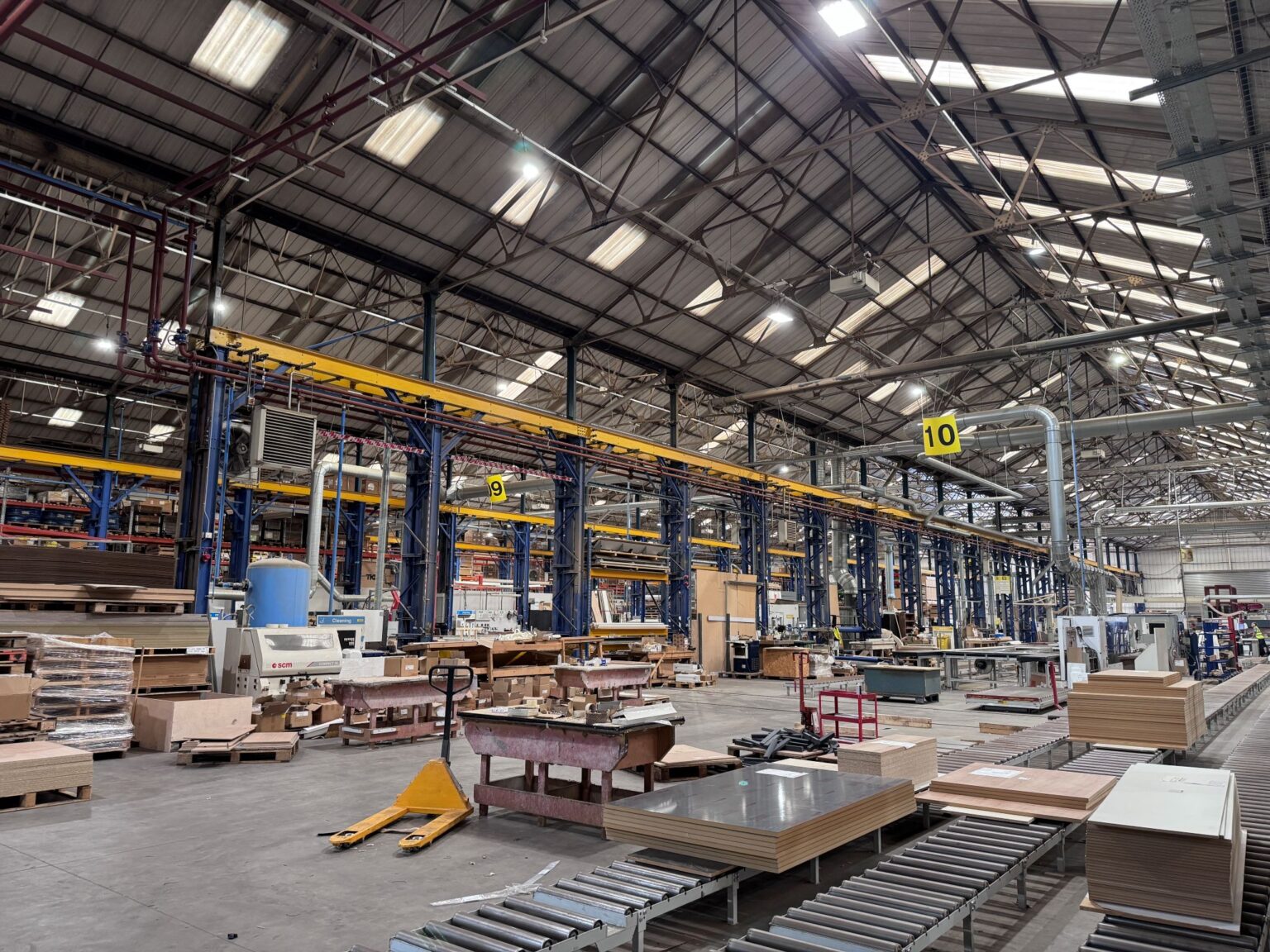
Lighting in industrial buildings is shaped by one legal duty, a set of technical standards that give that duty its numbers, and building and product rules that sit around both. This guide explains what each of them requires, where it applies and how they fit together for warehouses, factories, workshops, cold stores and their external areas.
The Legal Baseline
The law does not set lighting levels in lux. Regulation 8 of the Workplace (Health, Safety and Welfare) Regulations 1992 says every workplace “shall have suitable and sufficient lighting”, which must, so far as is reasonably practicable, be natural light. Standards and guidance then describe what “suitable and sufficient” looks like in practice.
The Health and Safety Executive’s guidance, HSG38 Lighting at Work, was published in 1997. It covers managing the risks from poor lighting, good practice and minimum recommended lighting levels, and is aimed mainly at employers and safety staff. BS EN 12464-1 is not itself law, but it is the yardstick most specifiers use when showing that a scheme is suitable and sufficient.
BS EN 12464-1: The Core Indoor Standard
BS EN 12464-1:2021 is the standard that sets lighting requirements for indoor workplaces, including most industrial interiors. BSI published it on 31 August 2021, and it replaced the 2011 edition, which has been withdrawn. It “specifies lighting requirements for humans in indoor workplaces”, considers all usual visual tasks, and excludes outdoor workplaces, underground mining and emergency lighting.
The standard works by task. Its tables give a maintained illuminance for each activity, which is the level the average illuminance on the task area must not fall below, and which must be achievable with artificial light alone. The immediate surrounding area is at least 0.5 m wide around the task area, and where the task area needs 750 lx or more, the surrounding area should be at least 500 lx. The background is a floor-level band at one third of the surrounding illuminance, at least 3 m wide in larger rooms.
The tabulated value is not always the final figure. Recommended illuminance steps run from 5 to 10,000 lx. One step up applies if one or two of six conditions are present, and two steps if more than two are. The conditions are costly errors, the need for accuracy or concentration, small or low-contrast details, long task duration, low daylight and below-normal visual capacity. One step down is allowed for large or high-contrast details or short tasks.
Recommended Values for Common Industrial Tasks
Published tables put most industrial tasks between 100 and 1,500 lx, with the highest values for fine, precise work. The figures below come from two published summaries of EN 12464-1: Ensto’s summary of the 2011 edition and DIALux’s list of standard values for the metalworking industries, which cites EN 12464-1. This table should be treated as a guide to scale rather than a specification. Please refer to the published standard or guidance for confirmed figures.
| Activity or area | Maintained illuminance (lx) | Maximum UGR | Minimum Rₐ | Source |
|---|---|---|---|---|
| Loading bays | 150 | 25 | 40 | [6] |
| Storage spaces | 100 (200 if work is continuous) | 25 | 60 | [6] |
| Technical facilities | 200 | 25 | 60 | [6] |
| Sheet metal working, over 5 mm | 200 | 25 | 60 | [8] |
| Assembly, rough | 200 | 25 | 80 | [8] |
| Rough and medium machining (tolerance over 0.1 mm) | 300 | 25 | 60 | [8] |
| Welding | 300 | 25 | 60 | [8] |
| Sheet metal working, under 5 mm | 300 | 22 | 60 | [8] |
| Assembly, medium | 300 | 25 | 80 | [8] |
| Precision machining (tolerance under 0.1 mm) | 500 | 19 | 60 | [8] |
| Assembly, fine | 500 | 22 | 80 | [8] |
| Marking, checking, measuring | 750 | 19 | 60 | [8] |
| Toolmaking and precision engineering | 1,000 | 19 | 80 | [8] |
| Electronics workshops, testing, adjustments | 1,500 | 16 | 80 | [6] |
Quality Criteria Beyond Lux
A scheme can hit its lux target and still fail the people using it, because the standard also sets limits for glare, uniformity, colour and flicker.
Glare: The standard uses the CIE unified glare rating (UGR), calculated for the luminaires and room being designed, with a maximum value for each application. UGR values run from 10 to 28. In the table above the limit is 25 for general work, 19 for precise work and 16 for electronics testing.
Uniformity: Uniformity is the ratio of the lowest to the average illuminance. The 2011 edition asks for at least 0.4 in the immediate surrounding area and 0.1 in the background.
Vertical and cylindrical illuminance: The 2021 tables include wall, ceiling and cylindrical values, with vertical and cylindrical levels of 50 to 150 lx depending on the activity. In a warehouse this affects how well vertical surfaces, such as racking faces, are lit.
Colour: Colour appearance is grouped by correlated colour temperature: warm below 3,300 K, neutral from 3,300 K to 5,300 K and cold above 5,300 K. Colour rendering is grouped from class 1A (Rₐ of 90 or more) down to class 4 (Rₐ from 20 to under 40). Most industrial tasks in the table above need Rₐ of 60 or 80.
Flicker and stroboscopic effect: The CIBSE Journal reports that systems should avoid flicker and stroboscopic effects across the full dimming range. This matters most around rotating machinery, where stroboscopic effects can mislead the eye.
Emergency Lighting: BS 5266-1 and BS EN 1838
Emergency lighting has its own standards, because BS EN 12464-1 does not cover it. The table below summarises EN 1838.
| Area | Minimum illuminance | Uniformity (max to min) | Time to switch on |
|---|---|---|---|
| Escape routes up to 2 m wide | 1 lx on the centre line at floor level, and at least 0.5 lx across the central half of the width | 40:1 | 50% within 5 s, 100% within 60 s |
| Open areas (anti-panic) | 0.5 lx at floor level, excluding a 0.5 m border | 40:1 | 50% within 5 s, 100% within 60 s |
| High risk task areas | 10% of the task’s required illuminance, and at least 15 lx | 10:1 | 0.5 s |
Colour rendering of at least Rₐ 40 applies throughout, and the rated duration is at least one hour. High risk task areas matter most in industrial buildings, where machinery or processes can stay dangerous after the normal lighting fails.
Testing is part of compliance. The Fire Protection Association recommends a monthly test, using the key switch rather than the mains switch, and an annual full-duration test of three hours under BS 5266-1, with a record of tests and faults kept. BS EN 62034:2012 covers the automatic test systems that carry out these tests and report results for self-contained luminaires or central battery systems.
Hazardous Areas: DSEAR and Explosive Atmospheres
Where a process can create an explosive atmosphere, lighting equipment must be certified for the zone it is installed in. The Dangerous Substances and Explosive Atmospheres Regulations 2002 (DSEAR) require these areas to be risk assessed before new work is carried out in them, and control measures to be put in place. Zoning is the duty holder’s job, based on how often an explosive atmosphere is likely to occur.
Equipment must be specially designed so that the risk of ignition is eliminated or reduced, assessed as suitable for the atmosphere it will be used in, and marked accordingly. In Great Britain it must be UKCA or CE marked with a Declaration of Conformity, and most new equipment sold for these atmospheres must have an ATEX certificate.
Installation is not the end of the duty. HSE says equipment should be regularly inspected and maintained by competent people, and points to BS EN 60079-17 for guidance on how often and how much. Luminaires chosen for an area where a hazardous atmosphere is possible should be treated as safety equipment, not as an ordinary product choice.
Maintenance Factors and Lumen Maintenance
BS EN 12464-1 asks for a maintained illuminance, so the design has to allow for the light a scheme loses over time. The maintenance factor does this, and it is the product of four terms: lamp or LED lumen maintenance, lamp survival, luminaire maintenance and room surface maintenance. The design delivers the required illuminance divided by this factor when new. For LEDs, lumen maintenance depends on the L-value. An L90 rating at 50,000 hours means the luminaire gives 90% of its original output after that time.
A sealed luminaire holds its output better in dusty buildings, and that a long cleaning interval costs real light. The maintenance factor assumed in the design should match a cleaning and replacement plan the site will actually follow.
Controls and Data Standards
Approved Document L sets the baseline for controls and metering, and a few technical standards sit behind how those controls work and how they are measured.
DALI (IEC 62386): DALI is a digital protocol for lighting control, defined in the multi-part international standard IEC 62386. Each device can be given its own address, groups can be changed by software without changing the wiring, and two-way communication lets a device report faults or answer status queries. The DALI-2 certification programme tests interoperability, and the results are independently verified by the DALI Alliance before certification is granted.
Automatic emergency test systems (BS EN 62034): This standard specifies the performance and safety requirements for automatic test systems used with emergency lighting systems, covering self-contained luminaires and central battery systems. It supports the testing duties described in the emergency lighting section.
The lighting energy numeric indicator (LENI): LENI is a measure of the efficiency of a whole lighting installation, including its controls, expressed in kWh per m² per year. It was originally defined by BS EN 15193:2007, and it depends on the illuminance needed and the annual hours of use. Its inputs include the power of the lighting, parasitic energy used by controls, the saving from occupancy-based switching, the saving from daylight-linked dimming and the loss of performance over the life of the system. Approved Document L accepts LENI as an alternative to the minimum efficacy route.
Standards at a Glance
| Standard or rule | What it covers | Where it applies |
|---|---|---|
| Workplace (Health, Safety and Welfare) Regulations 1992, regulation 8 | Suitable and sufficient lighting, and emergency lighting where people are exposed to danger | Workplaces in Great Britain, with some exclusions |
| HSG38 Lighting at Work (1997) | HSE guidance on risks, good practice and minimum levels | Workplaces |
| BS EN 12464-1:2021 | Lighting requirements for indoor workplaces | Industrial interiors, replacing the 2011 edition |
| EN 12464-2 | Lighting requirements for outdoor workplaces | Yards, loading areas and external routes. The 2014 BS edition was withdrawn in November 2024, so confirm the current edition |
| BS 5266-1 and EN 1838 | Emergency lighting design and illuminance | Escape routes, open areas, high risk task areas |
| BS EN 62034:2012 | Automatic test systems for emergency lighting | Self-contained and central battery systems |
| DSEAR 2002 and the 2016 equipment regulations | Zoning and equipment for explosive atmospheres | Areas with flammable gas, vapour or dust |
| Approved Document L, Volume 2 (2021) | Lighting efficacy, controls and metering | Buildings other than dwellings in England |
| Minimum energy efficiency standards (proposed changes) | EPC minimums for rented property | Privately rented non-domestic buildings in England and Wales |
| Electrical Equipment (Safety) Regulations 2016 | Product safety and UKCA or CE marking | Equipment of 50 to 1,000 V AC |
| Ecodesign (Lighting Products) Regulations 2021 | Ecodesign and labelling | Light sources and separate control gear |
| BS EN 60529 and BS EN 62262 | IP and IK ratings | Dust, water and impact protection of luminaires |
| IEC 62386 (DALI) | Digital lighting control protocol | Luminaires and control devices |
| BS EN 15193 (LENI) | Energy indicator for whole lighting installations | Energy compliance and design |
This article is intended as a general guide to lighting standards and typical design considerations. Lighting requirements may vary depending on the specific building, use and applicable regulations. Always refer to the latest guidance and standards, and seek professional advice when developing lighting designs.