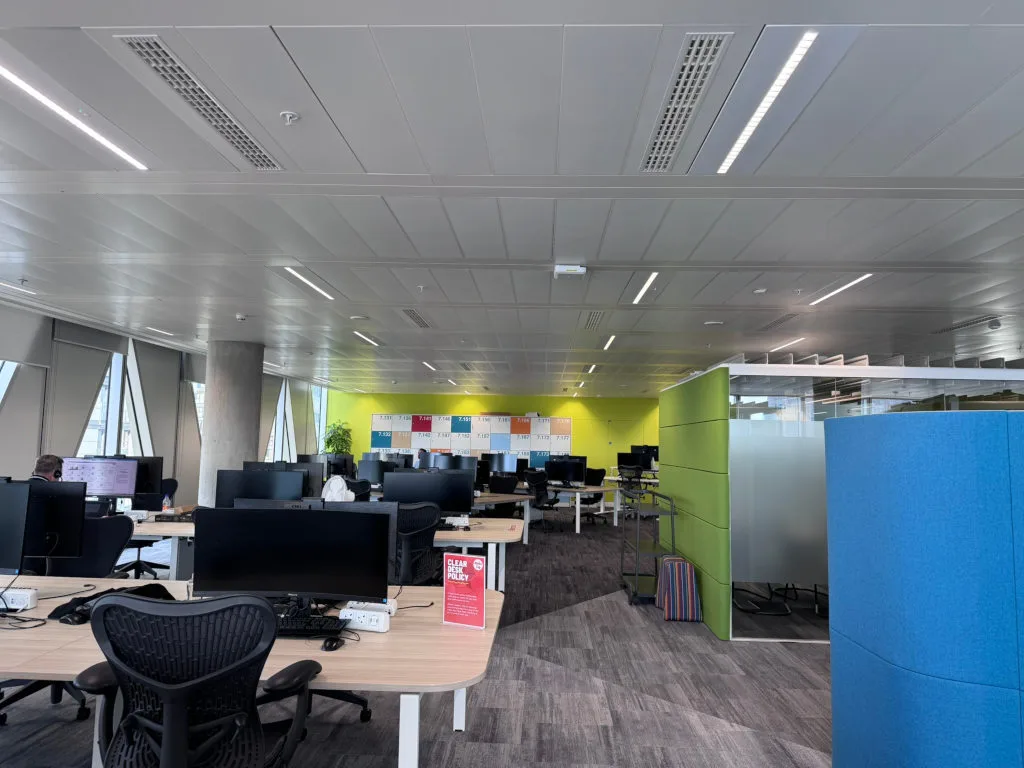
Office lighting has to satisfy two separate sets of rules at the same time which, in some cases, can be interpreted differently. CIBSE LG7 and BS EN 12464-1 set out how much light a space needs, how comfortable it has to be to work under, and how accurately it has to render colour. Part L of the Building Regulations sets out how little energy that lighting is allowed to use getting there. A scheme that passes one and fails the other is unlikely to be approved, and getting both right at once is where most specification problems actually happen.
CIBSE LG7: Lighting For Offices
CIBSE LG7, updated in 2023, is the UK industry’s standard reference for office lighting design. It isn’t a separate guide from CIBSE, but applies BS EN 12464-1, the European workplace lighting standard, to UK office conditions specifically, and adds guidance which EN 12464-1 doesn’t cover in detail, most notably how to handle glare from screens and mixed hybrid-working layouts. In practice, anyone working to LG7 is working to BS EN 12464-1’s figures with UK-specific interpretation layered on top.
LUX, UGR and CRI Requirments
Both standards define illuminance, glare and colour rendering by task, not by room. A reception desk and the open-plan area behind it are legitimately different lighting problems even though they’re the same physical space.
| Task or area | Maintained illuminance (lux) | UGR limit | Minimum Rₐ (CRI) |
|---|---|---|---|
| Filing, copying, circulation | 300 | 19 | 80 |
| Writing, reading, data processing, general desk work | 500 | 19 | 80 |
| CAD workstations | 500 | 19 | 80 |
| Conference and meeting rooms | 500 | 19 | 80 |
| Reception desk (general area) | 300 | 22 | 80 |
| Reception desk (reading/writing at the counter) | 500 | 22 | 80 |
| Archives | 200 | 25 | 80 |
UGR (Unified Glare Rating) is a measure of discomfort glare, and it gets stricter in spaces where people are doing careful visual work, which is why archives can run at UGR 25 but a CAD workstation is held to UGR 19. Rₐ of 80 is a floor, not a target, most modern LED office fittings sit well above it and there’s little reason to specify anything lower. Illuminance uniformity matters as much as the peak lux figure, the standard requires a uniformity ratio (U₀) of at least 0.60 across the task area at 0.75m height, so a design that hits 500 lux at one point and 250 lux two metres away fails even if the average looks fine on paper.
Energy Requirements
Approved Document L, the energy conservation part of the Building Regulations, sets independent levels. For non-domestic buildings, it requires an average luminaire efficacy of 95 lumens per circuit-watt across general lighting. Display and feature lighting is allowed a lower bar, since accent and colour-effect light sources are inherently less efficient than flat white general lighting.
| Lighting type | Minimum average efficacy |
|---|---|
| General lighting (non-domestic) | 95 luminaire lumens per circuit-watt |
| Display and feature lighting | 80 light source lumens per circuit-watt |
| High excitation purity sources (strong colour, low white content) | 65 lumens per circuit-watt |
| Display lighting, alternative route | 0.3 W/m² power density, or compliance via LENI |
Part L also mandates automatic controls, not just efficient fittings. Non-domestic lighting has to include daylight-responsive dimming or switching, and occupancy-based control is required for any fitting at or below 75 lumens per circuit-watt, with manual control only permitted above that threshold. The Building Research Establishment’s Digest 498 is the reference document cited for how to actually design and zone those controls.
There’s also an alternative compliance route worth knowing about: LENI, the Lighting Energy Numeric Indicator, drawn from BS EN 15193-1. Instead of judging individual fittings against a fixed lm/W threshold, LENI calculates a building’s actual annual lighting energy use in kWh per square metre, factoring in real operating hours, how much of that time lights are dimmed by daylight, and how much they’re switched off by occupancy detection. Used well, a strong controls strategy can offset a lower average fitting efficacy by as much as 30%, which matters on retrofit projects where the fittings are already partly decided and the controls are the only lever left.
Conflicts In Guidance
It’s entirely possible to hit 500 lux, UGR 19 and Rₐ 80 at every desk using fittings that individually clear 95 lm/circuit-watt, and still fail Part L on the LENI calculation, because LENI measures energy actually consumed over a year, not theoretical fitting efficiency. An office lit at full output from 7am to 7pm regardless of daylight or occupancy will use far more energy than the same fittings running under daylight-linked dimming and presence detection, even though the fittings themselves are identical on paper. Efficacy gets a scheme through the fitting-level check. Controls are usually what gets it through the building-level one.
A checklist for consultants, designers and contractors
- Confirm the illuminance, UGR and Rₐ target for each distinct task area, not a single figure for the whole floor
- Check maintained illuminance uniformity (Uₒ ≥ 0.60) across task areas, not just the peak lux value
- Verify luminaire efficacy against the 95 lm/circuit-watt general lighting threshold, and against 80 lm/circuit-watt for any display or feature lighting
- Specify daylight-responsive dimming and occupancy-based control as standard, not as an upgrade, given the mandatory threshold at 75 lm/circuit-watt
- Where fitting efficacy is constrained, such as on a retrofit, check whether the LENI route and a stronger controls strategy closes the gap
- Keep photometric and efficacy data on file for building control sign-off, since compliance is assessed on evidence, not on product claims
- BS 5266-1 governs emergency lighting provision separately, it sits alongside these standards rather than being replaced by them
Getting the fitting-level numbers right is the easier half of this. The harder half is proving the whole installation performs that way over a working year, which is a controls and evidence problem as much as a product one. Photometric files, efficacy data and compliance documentation for Trojan’s core range are available through the technical resources section for consultants, designers and contractors working against these standards now.
This article is intended as a general guide to lighting standards and typical design considerations. Lighting requirements may vary depending on the specific building, use and applicable regulations. Always refer to the latest guidance and standards, and seek professional advice when developing lighting designs.