The UK Regulatory Landscape and the Digital Imperative
The implementation of professional lighting within the United Kingdom built environment has shifted from a secondary consideration of how illumination effects the aesthetic to a primary driver of building performance, statutory compliance and decarbonisation. This transition is underpinned by a strict regulatory framework, most notably defined by the 2021 editions of Approved Document L of the Building Regulations: Volume 1 for dwellings and Volume 2 for buildings other than dwellings. These documents provide the legal mandate for energy efficiency, effectively transitioning lighting controls from an optional enhancement to a mandatory technical requirement for any modern installation. The second edition of Lighting Guide 14: Control of Electric Lighting (2023), published by the Society of Light and Lighting (SLL), provides the professional designer with a logical path to interpret these requirements, focusing on the consultation, design and commissioning of systems that must perform reliably throughout their lifecycle.
The term ‘lighting controls’ now encompasses a vast technical spectrum. For architects, it involves the sophisticated management of solar shading and daylight harvesting to enhance architectural form; for lighting designers, it means the integration of scene-setting and colour-temperature adjustments to support human circadian rhythms; and for estates managers, it is a tool for two-way communication, monitoring luminaire health and automating emergency lighting compliance. Modern compliance metrics like the Lighting Energy Numeric Indicator (LENI) have moved the industry towards a more scientific prediction of energy use, where the loads of sensors and control gear must be balanced against the significant de-rating factors achieved through automatic daylight linking and occupancy detection.
Technical Foundations: Wired DALI Systems
Digital Addressable Lighting Interface (DALI) has, for over two decades, served as the dominant protocol for digital lighting control. Standardised under the IEC 62386 series, DALI provided the first open-standard platform that allowed for granular, individual addressing of luminaires. Unlike the 0–10V or 1–10V analogue systems that preceded it, DALI utilises a digital signal sent over a 2-core bus, allowing for bidirectional communication. This means a fitting does not merely receive a command to dim; it can also report its status, energy consumption, and failure conditions back to a central head-end or Building Management System (BMS).
The technical architecture of DALI is defined by several critical ‘Parts’ of the IEC 62386 standard, ensuring that devices from different manufacturers can operate on the same bus. DALI-2 expanded this interoperability to include input devices such as sensors and wall stations, which were previously largely proprietary.
Despite this robustness, DALI systems are inherently restricted by their physical nature. A DALI bus is limited to 64 addresses and requires a dedicated 2-core cable, which can add labour and material costs. While the bus can be run alongside mains power, it is sensitive to topology constraints and total cable length, which cannot exceed 300 metres without the use of repeaters or routers. Furthermore, a physical break in the bus or the failure of a centralised DALI router can cause the collapse of an entire lighting zone, creating a significant single point of failure that is increasingly unacceptable in mission-critical environments like healthcare or high-security facilities.
The Wireless Revolution
The emergence of wireless mesh technology has initiated a shift that solves the fundamental limitations of wired DALI systems. Commercial-grade wireless protocols, particularly those based on Bluetooth Low Energy (BLE) or high-security proprietary mesh architectures, offer a decentralised system where intelligence is distributed across every node in the network. This transition is not merely about removing cables; it is about creating a self-healing, ultra-scalable infrastructure that is faster to deploy and more resilient to failure.
In a wireless mesh network, every luminaire, sensor, and switch acts as a repeater. This eliminates the need for central hubs or routers that characterize traditional wireless architectures like Wi-Fi or Zigbee, which rely on a ‘star’ or ‘hub-and-spoke’ model. In these legacy systems, if the hub goes offline, the entire network fails. In a mesh network, if a node is removed or fails, the remaining nodes automatically reroute signals to maintain continuity. This self-healing capability provides the level of reliability required for commercial and industrial applications, where uptime is directly linked to safety and productivity.
Furthermore, wireless systems can dramatically reduce the ’embodied carbon’ of an installation. By eliminating kilometres of copper control cabling and the associated steel or PVC containment, wireless controls align with the sustainability goals of CIBSE TM65 and TM66. The ability to perform ‘over-the-air’ (OTA) firmware updates ensures that these systems are future-proofed, allowing new features or security patches to be deployed without site visits or hardware changes.
Ultra-Scalable Distributed Intelligence for Infrastructure
Mymesh is engineered for large-scale, professional environments where security and scalability are the primary drivers. It is a radio-agnostic protocol that can connect up to 10,000 devices on a single network, making it the preferred choice for massive infrastructures like airports, shopping centres, and hospitals. The protocol differentiates itself from standard consumer-grade wireless solutions by utilising a ‘managed flooding’ mechanism, ensuring that control signals reach their destination via multiple paths with extremely low latency.
Mymesh utilizes a ‘Secure by Design’ architecture that rivals the standards used in the banking and payment industries. Security is integrated at the hardware level; each node contains unique crypto-keys that are stored in protected areas of the silicon.
- Rotating Encryption: The system changes its encryption keys every 10 seconds, effectively neutralising the risk of replay attacks or signal interception.
- Physical Protection: If an unauthorized user attempts to probe the internal memory of a Mymesh chip, the device is designed to automatically wipe its internal configuration to prevent data theft.
- Decentralised Decision Making: There is no central computer. If 90% of the network nodes were destroyed, the remaining 10% would continue to function autonomously within their programmed parameters.
Trojan Lighting Case Study: St Thomas’ Hospital NHS Trust
The success of Mymesh is best demonstrated in the healthcare sector, where we implemented a major upgrade at St Thomas’ Hospital in London. The project faced the immense challenge of modernising the lighting without disturbing the hospital’s metal-integrated ceilings or interrupting patient care in the wards.
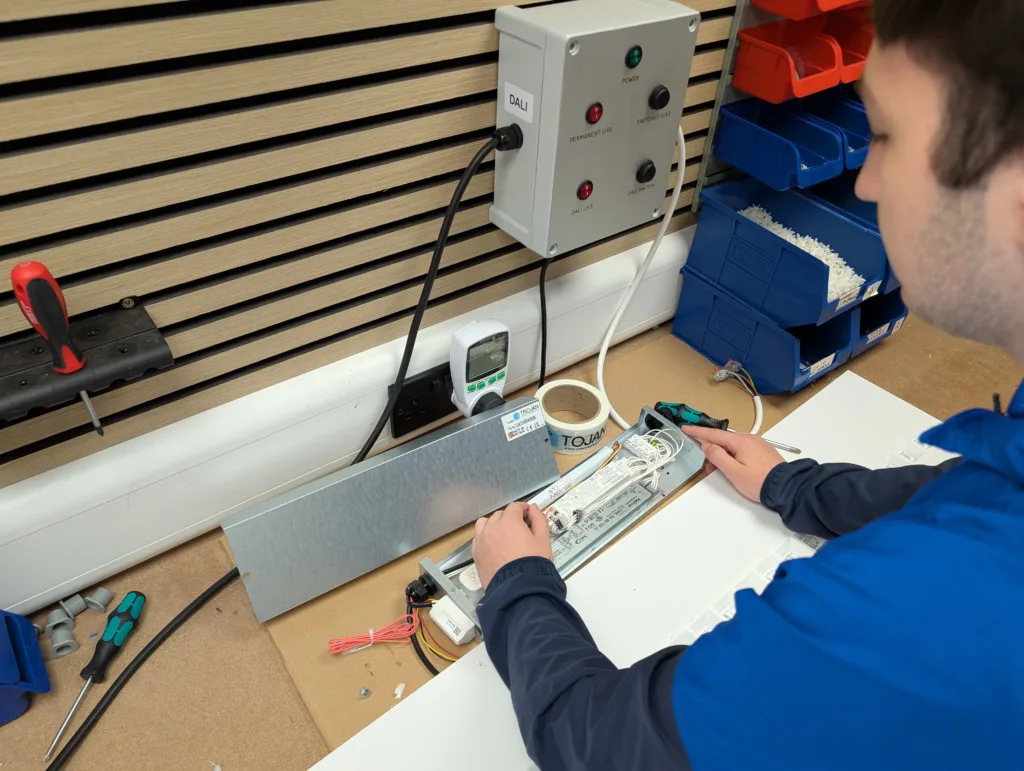
Our approach involved reconditioning the existing fluorescent luminaires on-site, retrofitting them with energy-efficient LED gear trays and intelligent Mymesh nodes. This ‘circular’ strategy avoided the waste of replacing thousands of luminaire bodies. By adding wireless Mymesh nodes, the hospital gained granular occupancy and daylight control. Critically, the medical physics team conducted exhaustive trials to ensure the Mymesh signals did not interfere with sensitive clinical equipment, confirming that professional-grade mesh systems are safe for intensive care and surgical environments. The system now automates the testing and reporting of emergency lighting ensuring 100% compliance with BS 5266-1 with a complete digital audit trail.
The Ecosystem of Aesthetic Control and Flexibility
While Mymesh excels in large-scale infrastructure, Casambi has established itself as the global standard for architectural, retail and commercial projects where the user experience and flexibility of the ecosystem are paramount. Based on Bluetooth Low Energy (BLE), Casambi provides an interface between professional lighting and the mobile devices used by every modern occupant.
Software-Defined Lighting and iBeacons
Casambi moves the complexity of lighting control from physical wires to a software layer. This ‘rewiring’ in software allows for limitless reconfiguration without needing to access the ceiling.
- Bluetooth Mesh Logic: Casambi nodes act as a self-organizing mesh where each node carries a backup of the entire network’s configuration. This decentralisation ensures that the network is robust and free from single points of failure.
- Indoor Positioning: Each Casambi node can broadcast iBeacon profiles, allowing the lighting system to serve as an indoor GPS. Retailers can use this data for customer heatmapping or to trigger location-based offers, while commercial offices can use it to track assets or manage hot-desking.
- Integrative Lighting (Circadian Curves): Casambi supports Tunable White (TW) and colour control out-of-the-box, allowing designers to program lighting profiles that mimic the natural cycle of daylight, improving staff productivity and wellness.
Trojan Lighting Case Study: GAP Covent Garden Flagship
We delivered a sophisticated Casambi-based lighting scheme for GAP’s flagship relaunch in Covent Garden. The retail brief required a high-energy environment where merchandise visibility was the absolute priority. We utilised a combination of Poplar track spotlights and Acorn recessed downlights, all controlled via Casambi wireless mesh.
The integration allowed for precise scene setting, where window displays and skylight recesses utilize DMX-controlled RGB units to create programmable colour washes after dark. Because the system is wireless, the GAP facilities team can regroup luminaires or adjust light levels through an app as floor layouts change seasonally, ensuring the lighting design remains aligned with the retail strategy without the cost of rewiring. The project also integrated Mallard recessed self-test emergency luminaires, providing automated safety compliance that is invisible to the consumer.
The Economic Argument: Reducing Installation and Lifecycle Costs
One of the most persistent myths in the industry is that wireless systems are more expensive than wired DALI. While the individual component cost of a wireless driver or sensor carries a slight premium, the Total Cost of Ownership (TCO) is overwhelmingly in favour of wireless.
Labour and Construction Efficiencies
Independent research indicates that the majority of costs in a wired lighting installation are linked to labour, cabling, and structural repair. A wireless retrofit can halving these installation costs by removing the traditional bottlenecks of electrical work.
| Wired DALI Cost Drivers | Wireless Mesh Advantage | Economic Impact |
| Cabling: Requires 5-core (Power + DALI). | 3-Core Only: Uses standard mains power. | Saves ~30% on material costs. |
| Containment: Heavy trunking/basket required. | Existing Routes: Minimal new containment. | Reduces install time by 50%. |
| Labour: High (pulling, termination, stripping). | Click and Done: Luminaire assembly is fast. | Halves on-site labour hours. |
| Structural Repair: Walls/ceilings often damaged. | No Disturbance: Preserves building fabric. | Saves thousands in plastering/paint. |
| Programming: Specialist technician on-site. | App Commissioning: Done by the installer. | Faster project handover. |
| Troubleshooting: Manual tracing of cable faults. | Remote ID: Node status via dashboard. | Lowers ongoing OpEx costs. |
By utilising wireless technology, contractors can complete twice as many projects in the same timeframe as a wired retrofit. In speculative office fit-outs, where the final tenant layout is unknown, wireless provides the only viable option for a ‘day one’ system that can be adapted without capital expenditure when the space is finally occupied.
Trojan Lighting Case Study: Queensgate Shopping Centre Car Park
The Queensgate project demonstrates the rapid ROI achievable with intelligent wireless systems. Replacing outdated lighting with an integrated Mymesh network across 1,200 lighting assets resulted in energy savings of up to 70%. The project was delivered two weeks ahead of schedule because no control wiring was required, allowing the car park to remain operational throughout the process. The ROI was modeled at under two years, proving that for large-scale assets, wireless is the most fiscally responsible choice.
Sustainability: Embodied Carbon and the Circular Economy
The lighting industry has historically focused on ‘operational carbon’, the energy consumed during the use of a luminaire. However, as UK energy grids decarbonise, the ’embodied carbon’ of the materials used in construction has become the new frontier of sustainability. CIBSE TM65.2 provides the first methodology to quantify the CO2e (Carbon Dioxide equivalent) emissions associated with the extraction, manufacture, and transport of lighting equipment.
The Material Advantage of Wireless
A wired DALI system for a 100,000-square-foot office involves several tonnes of additional material. Kilometres of copper cable and the PVC jacketing required for a DALI bus carry a high carbon footprint. Wireless systems eliminate this burden entirely.
- TM65.2 Compliance: Specifying wireless controls significantly lowers the embodied carbon score of a project, a key metric for developers seeking BREEAM ‘Excellent’ or ‘Outstanding’ status.
- Reducing E-Waste: The ability to retrofit wireless nodes to existing luminaires, as seen in our work at St Thomas’ Hospital, extends the lifecycle of high-value components like aluminium housings and steel gear trays, aligning with ‘Cradle-to-Cradle’ and circular economy principles.
- Material Minimisation: In building energy management systems (BEMS), moving to network-powered or wireless field devices reduces the size and carbon intensity of control enclosures.
Trojan Lighting Case Study: Bluewater Shopping Centre
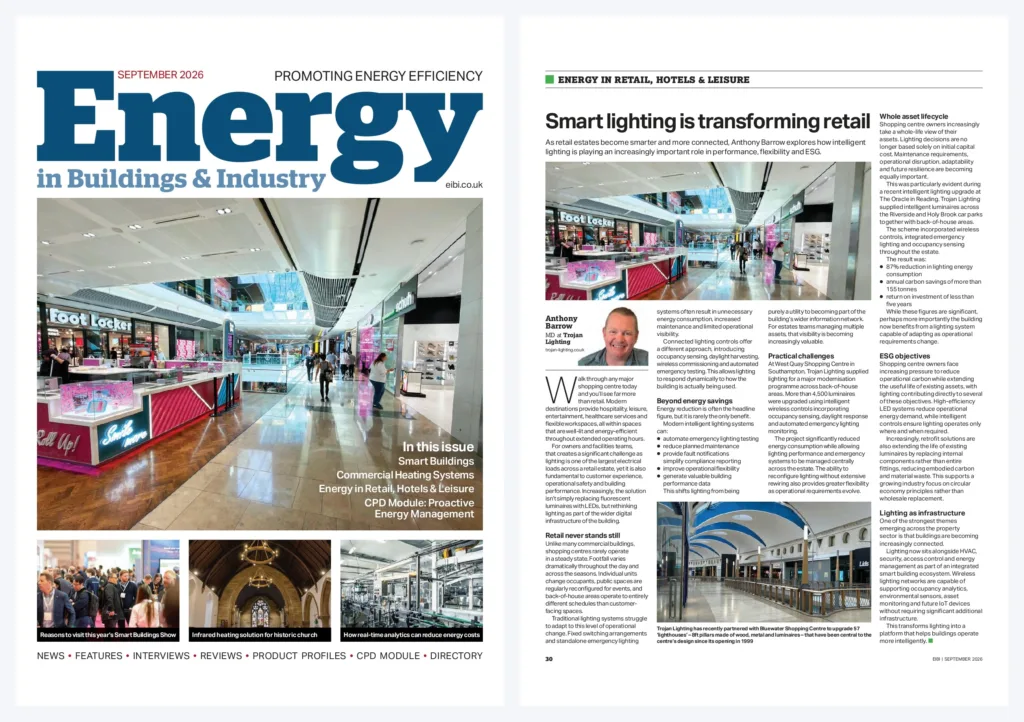
At Bluewater, we retrofitted 57 iconic ‘lighthouse’ luminaires along Thames Walk. By preserving the architectural housings and upgrading only the internal light engines with DALI-based controls for smart management, the project achieved a 59% reduction in energy consumption. This selective retrofit strategy minimised the embodied carbon impact by reusing the heavy structural components of the fittings while gaining the energy performance of a brand-new system.
Human Interaction: Designing Systems “What Actually Works”
A common failure in lighting control design is the assumption that total automation is ideal. Research from the Building Research Establishment (BRE) highlights that occupants who feel they have no control over their environment are less satisfied and more likely to bypass the system. SLL LG14 (2023) classifies indoor spaces into six types to help designers select the appropriate level of interaction.
Space Classification and Control Strategy
| Space Class | How Space is Used | Recommended Control |
| Owned Spaces | Individual office or consulting room. | Absence detection with manual dimming. |
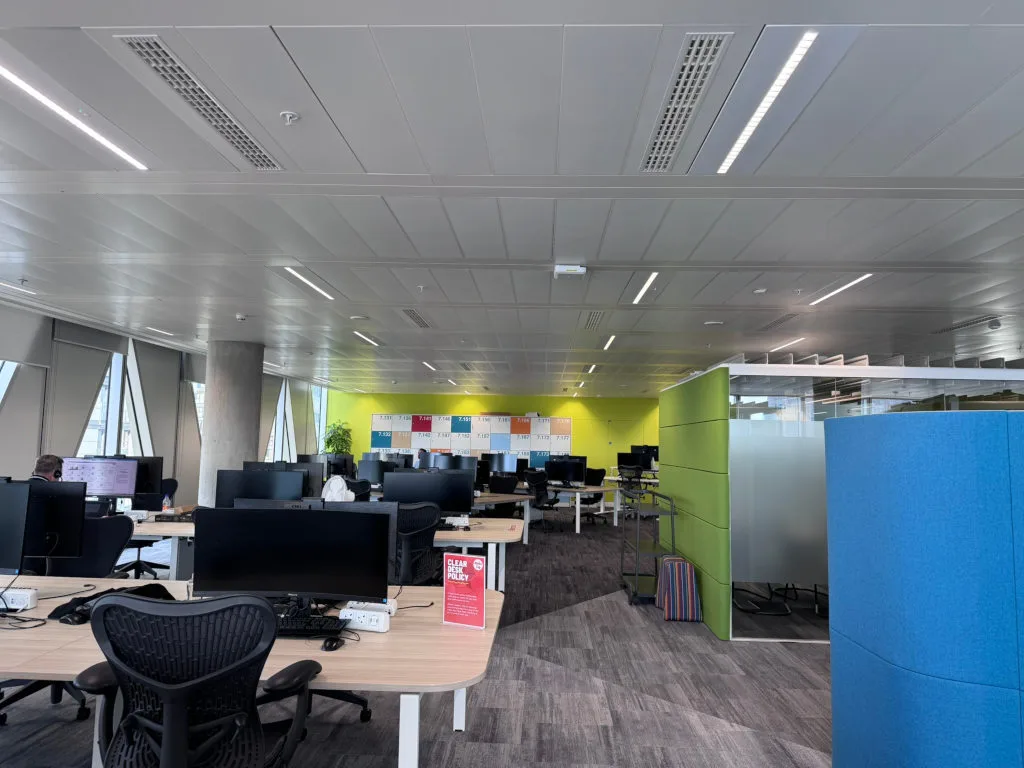
| Shared Spaces | Open plan offices or study areas. | Granular absence detection over desk zones. |
| Temporarily Owned | Classrooms, meeting rooms, patient wards. | Scene selection buttons for teaching/diagnostics. |
| Managed Spaces | Retail, hotel foyers, places of worship. | Pre-set scenes via astronomical time clock. |
| Unowned Spaces | Circulation, stairs, general open areas. | Presence detection with staged timeouts. |
| Occasionally Visited | WCs, stores, plant rooms. | Presence detection (subject to risk assessment). |
Overcoming “Nuisance Switching”
Systems that ‘actually work’ avoid the frustration of lights suddenly turning off when an occupant is sitting still. Professional commissioning must implement ‘Staged Timeouts’. Instead of an abrupt switch-off, lights should dim from 100% to 50%, then to 10% for five minutes before turning off. This provides a visual warning to the occupant, allowing them to reset the sensor with minor movement before being plunged into darkness. Wireless mesh systems like Mymesh and Casambi allow these timeout parameters to be tuned globally or per-luminaire instantly via software, ensuring the system evolves as the building’s usage patterns change.
Lighting as the Building’s Sensory Infrastructure (IoT)
The lighting network is the only utility that is present in every occupied space and connected to a permanent power source. This makes it the ideal ‘onramp’ for the Internet of Things (IoT) and intelligent buildings. Modern wireless mesh networks allow luminaires to serve as a high-density sensory grid, capturing and sharing data that was previously too expensive to collect.
Environmental and Occupancy Mapping
By integrating environmental sensors into the wireless lighting node, a building gains the ability to monitor its own health in real-time.
- HVAC Integration: Data from PIR sensors in the lighting mesh can be shared with the BMS via a Cloud API or gateway (BACnet/MQTT). This allows the building to heat or cool only the rooms that are actually occupied, potentially saving an additional 20-30% on building-wide energy costs.
- Air Quality Monitoring: Nodes can be equipped with sensors for CO2, humidity, and Volatile Organic Compounds (VOCs), feeding data back to a central dashboard to ensure occupant health and concentration levels are maintained.
- Heatmapping: In retail environments, tracking occupant dwell time through the mesh allows for the optimization of store layouts and staffing rotas.
Trojan Lighting Case Study: Hospital Operating Theatres
Our work in operating theatres exemplifies the integration of lighting with critical hygiene standards. In these sterile environments, any physical maintenance is highly disruptive. The integration of high-reliability LED technology and automated wireless monitoring reduced the need for physical inspections by 80%. The system provides live usage data, ensuring that theatre lighting is only at 100% during surgical procedures, while maintaining a safe, low-energy ambient level during cleaning or downtime, contributing to an overall energy saving of 66%.
Statutory Compliance: Automated Emergency Lighting
Emergency lighting is a mandatory life safety system under the Regulatory Reform (Fire Safety) Order and BS 5266-1. The historical method of manual monthly testing, where a technician walks the entire site with a clipboard, is prone to error, expensive, and often neglected.
The Wireless ATS (Automatic Test System) Advantage
Wireless mesh systems allow for the creation of a robust Automatic Test System (ATS) that conforms to IEC 62034.
- Scheduled Testing: Nodes are programmed to perform short functional tests monthly and full duration tests annually during out-of-hours periods.
- Autonomous Reporting: If a battery fails or a driver malfunctions, the node transmits a fault code through the mesh to a central dashboard.
- Digital Audit Trail: The system generates automated compliance reports that can be presented to fire inspectors, removing the risk of missed tests and providing legal protection for building owners.
Our emergency lighting ranges utilise this technology to provide ‘discreet safety’. In high-end retail or corporate offices, where ugly emergency boxes are unwelcome, we integrate the wireless emergency hardware directly into the architectural luminaires, ensuring compliance without compromising the interior design.
Comparative Analysis: Technical Parameters
For the professional specifier, the choice between Mymesh and Casambi depends on the specific project archetype.
| Feature | Mymesh Protocol | Casambi BLE Mesh |
| Primary Philosophy | Distributed Intelligence Infrastructure | Software-Defined User Ecosystem |
| Maximum Nodes | 10,000+ per network | 250 (Classic) / Unlimited (Site) |
| Frequencies | 2.4GHz (Indoor) / 868MHz (Outdoor) | 2.4GHz (Standard BLE) |
| Security | Bank-level, 10s rotating keys | AES-128 Encrypted device-to-device |
| Setup Tool | Commissioning Tablet / PC | iOS / Android App |
| Interoperability | OEM Agnostic (Works with all) | “Casambi Ready” certified partners |
Both systems remove the single point of failure and significantly lower CapEx through reduced material and labour requirements.
Designing for Net Zero: LENI and De-rating Factors
Under BS EN 15193-1, the Lighting Energy Numeric Indicator (LENI) is the primary metric for verifying a design’s efficiency. It accounts for the actual energy consumed over a year, including standby power. Wireless controls allow designers to apply significant ‘de-rating factors’ to their calculations, making the difference between building compliance and failure.
- Constant Illuminance: Compensates for the ‘maintenance factor’ of new LEDs, dimming them initially and slowly increasing power as they age. This saves ~10-15% energy over the first year.
- Daylight Linking Automatically dims rows of luminaires parallel to windows. In well-lit offices, this can reduce lighting load by up to 60% during daylight hours.
- Occupancy Dependency: Ensures light is only present when needed. Moving from presence (auto-on) to absence (manual-on) detection often adds a further 20% saving.
Our ROI calculator models these factors to provide clients with a clear picture of potential savings. At one major retail warehouse, our integrated strategy led to energy savings of 85% by combining high-efficacy LEDs with demand-driven Mymesh control.
The Path to Building Intelligence
While DALI-2 remains a robust protocol for certain infrastructure, the advantages of wireless mesh networks in terms of resiliency, installation speed, and sustainability make them the definitive choice for the professional designer.
Our implementation of Mymesh and Casambi across critical sectors like healthcare, high-end retail, and large-scale logistics, demonstrates that these systems are no longer ’emerging’, they are a proven standard. By removing the “copper and PVC” burden, wireless controls allow the industry to focus on what actually works: creating responsive, high-performance environments that support human wellbeing while delivering the deep energy savings required to reach the UK’s 2050 Net Zero targets. For the modern building services engineer, a wireless mesh infrastructure is not just a lighting control system; it is the data backbone of the future smart building.